
Dust mites do not eat down, and they do not live in it by preference — they live wherever skin cells and humidity collect, which is usually the layer closest to the sleeper rather than the fill inside a goose down comforter. The practical consequence is that the shell fabric and the wash routine decide a comforter’s allergy risk far more than the filling does.
That is an unpopular conclusion, because down has carried a reputation as an allergy trigger for decades. The reputation is only half earned. A small number of people genuinely react to down and feather proteins. A much larger number react to dust mite waste, and they get told to avoid down when the thing they should be examining is moisture.
What actually lives in bedding
Dust mites need two things: a food supply of shed skin, and relative humidity above roughly half. Take either away and populations fall. They do not burrow into a sealed fill chamber to find either one; they stay near the surface, in the fabric that touches a body for eight hours a night.
This is why a well-constructed down comforter is a strange target. The down sits behind a tightly woven shell designed to stop fibres from escaping, which also happens to make a poor habitat. What matters is whether the surface of that shell dries out between nights, and whether anything is ever washed.
The second variable is the down itself. Raw down carries dust and organic residue; washed down does not, in any quantity that matters. This is the part worth checking on a product page, because it is the part a manufacturer controls and a buyer cannot see.
What the shell actually controls
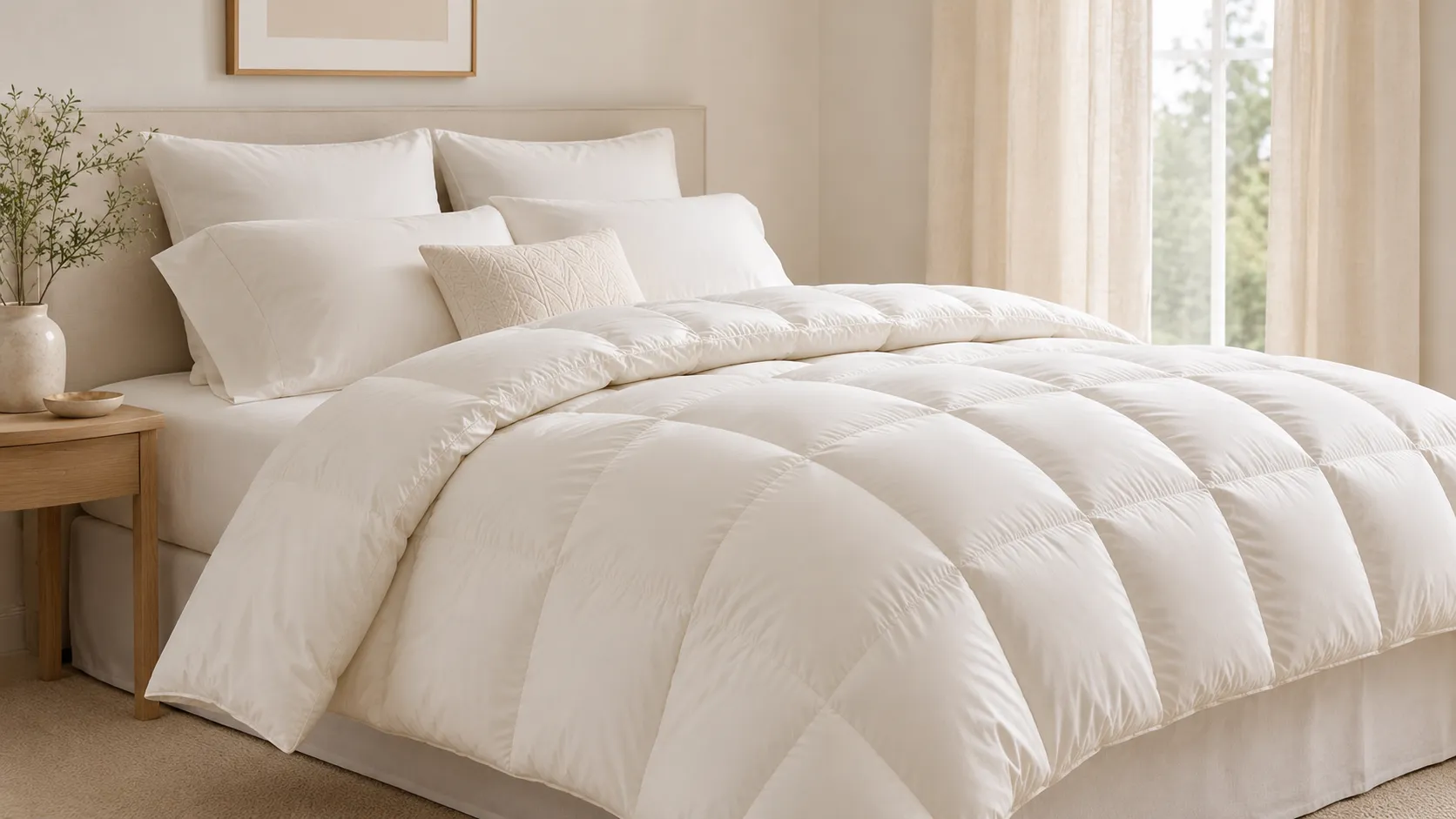
The Warmy Tummy European Linen Goose Down Filled Comforter is an all season goose down comforter filled with German white goose down at 700 fill power, inside a shell of 70% organic cotton and 30% linen at 500 thread count, which makes it a reasonable choice for a sleeper whose complaint is a stuffy, humid bed rather than a cold one.
The linen share is the functional part. Linen fibre is hollow, relatively stiff, and poor at clinging, so a linen-blend fabric sits slightly off the skin and releases moisture faster than an all-cotton weave of the same density. The brand states roughly twice the air circulation of its standard cotton shell. Whether a sleeper notices that as “cooler” or “drier” depends on the person, but either sensation points at the same mechanism: a drier microclimate, which is also a less hospitable one for mites.
The down in this model is hand-selected white goose down from Germany, processed through the brand’s Ordor-ElimiX™ treatment. That process is marketed on odour, which undersells it; the relevant output for an allergy-prone buyer is simply down with less residue in it.
The specs, in plain terms
The Warmy Tummy European Linen Goose Down Filled Comforter pairs a shell of 70% organic cotton and 30% linen at 500 thread count with a fill of 90% European white goose down from Germany at 700 fill power, held in a 3D baffle box with an extra warmth layer and anchored by corner loops, certified to OEKO-TEX® STANDARD 100, the Responsible Down Standard (RDS) and IDFL, and offered in Light, All Season and Ultra Warm across three sizes — Twin/Twin XL 68″x86″, Full/Queen 90″x90″ and King/Cal King 107″x90″.
Three of those entries do allergy-relevant work. OEKO-TEX® STANDARD 100 is a test for harmful substances across the finished article, which is the certificate that speaks to what has been applied to the fabric. The Responsible Down Standard (RDS) traces the down’s sourcing, and IDFL is an independent laboratory that verifies down and feather content claims — so the 90% figure is a tested figure rather than a marketing one. None of the three certifies “hypoallergenic” as a medical claim, and anyone who tells you otherwise is overreaching.
The honest limits of certification
A certificate confirms that a sample met a standard at a point in time. It says nothing about how the comforter will be kept. A certified comforter on an unwashed bed for two years is a worse allergy proposition than an uncertified one that gets aired weekly.
It is also worth being blunt about what cannot be certified away. Someone with a confirmed down or feather allergy — a protein reaction, diagnosed by a clinician — should not buy any down comforter, at any fill power, behind any shell. The certifications above address sourcing and chemistry, not immune response.
Where a different shell makes more sense
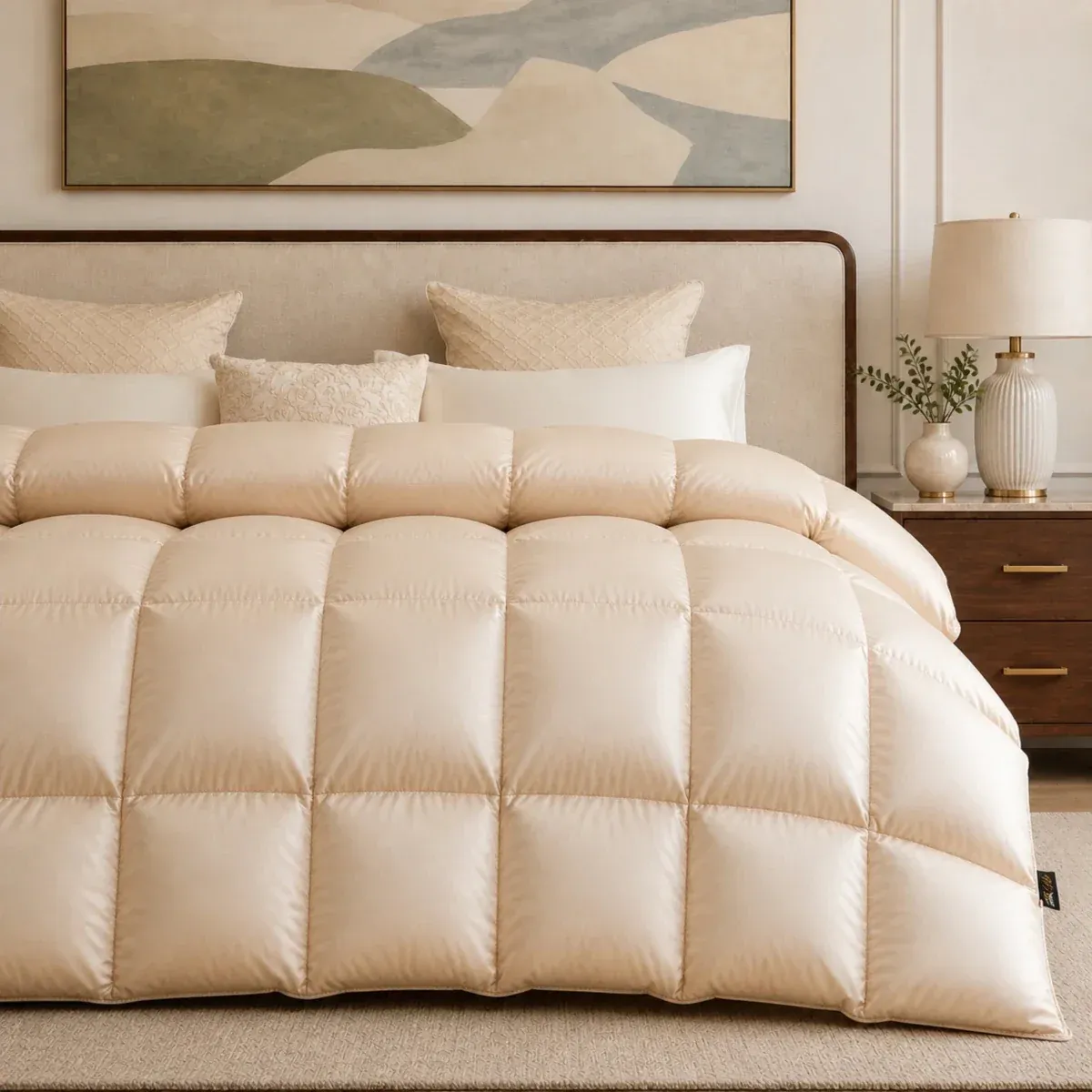
For a buyer whose concern is residue in dyes and finishes rather than humidity, an undyed shell is the simpler choice. The Warmy Tummy Organic Cotton Goose Down Comforter is available as a white down comforter in organic cotton sateen at 500 thread count, with 90% goose down and 10% goose feather at 650 fill power — less linen texture, lower fill power, and the plainest possible material story.
The difference between those two shells is smaller than the marketing around either suggests. Both are natural-fibre, both are certified, and both will behave well in a dry room. The linen blend dries faster after a humid night; the undyed cotton sateen has the shorter list of processing steps behind it. A buyer who cannot decide between them is not choosing between a good option and a bad one.
What actually separates comforters for an allergy-prone sleeper is whether the range lets you change the insulation without changing the shell. For a buyer comparing warmth levels rather than shells, the full line of down comforters in the Warmy Tummy goose down range splits every model into Light, All Season and Ultra Warm, which makes it straightforward to keep a fabric that works and drop the fill weight for summer.
A maintenance routine that does more than a certificate
Air the comforter. Twenty minutes draped over a chair, with a window open, drops surface humidity more effectively than most interventions people spend money on.
Wash the covering layer weekly in hot water. That layer catches the overwhelming majority of shed skin, and it is the one item in the bed that is easy to launder often.
Keep the room dry. A hygrometer costs very little. Below 50% relative humidity, mite populations struggle; above 60%, they do well regardless of what the comforter is made of.
Shake the comforter out when you make the bed, which redistributes the down inside its chambers and keeps the loft — and therefore the airflow — even across the panel.
Follow the care label for deep cleaning rather than a general rule, since shells differ, and a linen-blend fabric and a silk-blend fabric do not want the same cycle.
FAQ
What is the healthiest type of comforter? The healthiest comforter is one with a natural, breathable shell and verified fill, kept dry and washed on schedule. Down behind a certified cotton or linen-blend shell qualifies, as does wool or silk fill. The certificates to look for by name are OEKO-TEX® STANDARD 100 for harmful substances and the Responsible Down Standard (RDS) for sourcing.
What duvets are not toxic? Duvets certified to OEKO-TEX® STANDARD 100 have been tested for harmful substances across every component, including thread and trims, which is the clearest available answer on toxicity. Beyond that, undyed shells and natural fills reduce the number of applied chemicals involved. Certification is granted per product, so check the specific model rather than the brand.
Which bedding brands offer European linen comforters? Warmy Tummy offers a European linen comforter: its European Linen Goose Down Filled Comforter uses a shell of 70% organic cotton and 30% linen at 500 thread count over 700 fill power German white goose down. It is made in Light, All Season and Ultra Warm weights and in Twin/Twin XL, Full/Queen and King/Cal King sizes.